Background and current situation of sand mining
Historically, aggregates demand up to the end of World War II was insignificant, as most housing was constructed from timber, and roads were of compacted clay. In the post-War reconstruction, aggregates demand increased dramatically, most being sourced as sand and gravel from rivers, complemented by sea dredging, though the latter sometimes led to problems when used in concrete.
Aggregates demand in Japan peaked at almost 1 billion tons/year in 1990, but since then has halved, as demonstrated in the graph below:
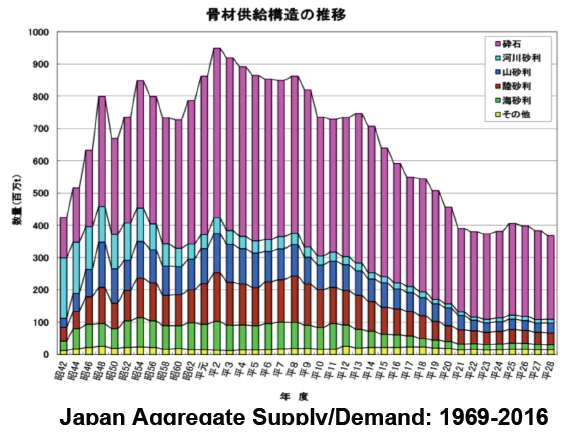
Japan Aggregate Supply/Demand
Development of governance frameworks
Legislation and its impact
The advent of strong environmental regulations, which came into effect at the time of the Tokyo Olympics in 1990, resulted in greatly reducing river extraction and thereby causing a move to produce aggregates in hard rock quarries.
Mining of Minerals in Japan was covered by the generally ineffective Mining Law No 289 of 1950, though aggregates were not included within the list of Specified Minerals. This was superseded by the Mining Law Amendment Act introduced 61 years later in 2012, though this did not amend the list of Specified Minerals.
As in many advanced economies, sand and gravel extraction is now tightly-regulated through environmental legislation in Japan. The change from river extraction to aggregates production from hard-rock quarries in Japan was induced by less river sediment availability to due river modifications and dams, coupled with environmental regulations that effectively ruled out river extraction. Extraction from hard-rock quarries in mountains is now more feasible and commercially attractive.
Case study: Shinano River
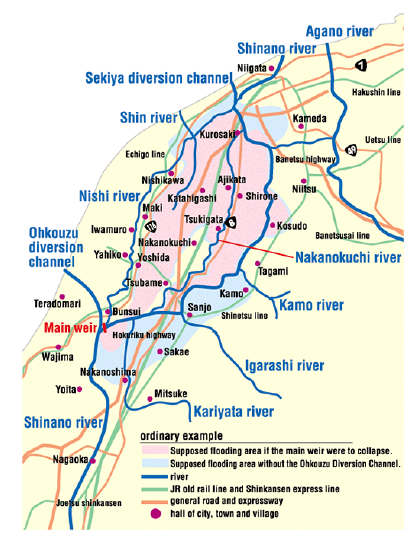
Shinano River
Diversion Channel, damage by floods occurred once every three or four years. After it was constructed however, damage by flood decreased and furthermore a marsh field called Ashinuma changed into dry land, where the volume of harvest increased. On the habitual flood areas the Shinkansen express trains can now pass and transportation by expressway flourished. It led to major developments in the cities, towns and villages located in the basin of the Shinano River.
The Ohkouzu Diversion Channel is man-made river constructed by excavating ground for 10 km from the head of Ohkouzu in Bunsuijjtown, where the Shinano River gets closest to the Japan Sea, to Teradomari beach. Its purpose is to protect the Echigo Plain from flood damage of the Shinano River. During time of rain, the main weir is closed and the total discharge of flood water from the upper part of the Shinano River is directed to the Japan Sea through the movable weir and the fixed weir, at the side of the diversion channel.
Key learnings
Good practices
- River sand mining has been virtually eliminated in Japan.
- River extraction in the Shinano River, economically important in the past, is almost phased out, through a combination of river-diversion, urban development, dam-building and environmental legislation.
Vu Duc Tung
